



If you bill maternity, the most consequential document of the next ten weeks is not a payer bulletin. It is the CMS Physician Fee Schedule final rule, expected in November 2026.
Two of the largest commercial payers in the country have now said, in writing, that what you bill in January depends on what that rule says.
UnitedHealthcare published two answers
In its October 2026 Commercial Reimbursement Policy Update Bulletin, effective 1/1/2027, UnitedHealthcare set out a fork:
At the time of publication, CMS has proposed maternity care reporting changes that are expected to be finalized November 2026. UnitedHealthcare will review the final CMS guidance and implement any applicable CMS requirements effective Jan. 1, 2027.
If CMS finalizes its proposed 2027 maternity HCPCS G-codes as originally proposed, including being effective January 1, 2027, providers should report maternity services using the applicable CMS-designated HCPCS G-codes.
If the CMS proposal is not finalized as proposed, effective Jan. 1, 2027, CPT maternity care services will transition from global obstetric reporting to phase-based reporting, including antepartum, labor management, delivery, and postpartum care.
Two different code sets. One decision, not theirs, landing about six weeks before go-live.
The bulletin is specific about the transition itself:
Services rendered on or before Dec. 31, 2026, should be reported in accordance with CPT 2026 guidelines, including CPT 59425, 59426, or applicable E/M services.
Services rendered on or after Jan. 1, 2027, should be reported using the appropriate E/M code. Antepartum-only global obstetric CPT codes will no longer apply to services rendered in 2027 and beyond.
Antepartum and Postpartum services should be reported with the appropriate E/M code, modifier TH, and the appropriate obstetrical primary diagnosis.
And one detail that will cost someone money if it is missed:
Dipstick urinalysis services performed during the antepartum period will not be considered for separate reimbursement.
Cigna is waiting on the same rule
Cigna's update on maternity coding and reimbursement, updated 15 October 2026, takes the same position:
As the industry continues to await the Centers for Medicare & Medicaid Services (CMS) final rule regarding maternity care coding for 2027, Cigna Healthcare continues to evaluate and refine potential coding implementation approaches.
Its instruction for right now is to change nothing:
Continue to bill and report maternity services in accordance with existing contractual requirements and Cigna Healthcare reimbursement policies.
And it is explicit that you should not move early. For initial prenatal visits on or after 1 September 2026, Cigna tells providers not to submit the ACOG-proposed and AMA-recommended prenatal care E/M CPT codes.
That matters, because other payers are telling you the opposite.
Meanwhile, two payers already moved
Highmark is not waiting. Its guidance on the new coding and billing model for maternity care, published 28 September 2026, keys the change to the due date and started three weeks ago:
For pregnant members with due dates on or after Jan. 1, 2027, providers should begin transitioning to the new billing model on Oct. 1, 2026.
All patients who initiate maternity care on or after Oct. 1 must be billed under the new model and are not eligible for global maternity billing. For pregnant patients with due dates on or before Dec. 31, 2026, continue to use the current billing system.
Aetna moved earlier still, and uses a different test again: a visit count. From its October 2026 OfficeLink Updates:
For patients expected to deliver in 2027, preventive prenatal visits on or after September 1, 2026, should be billed with the applicable E/M code, modifier TH and pregnancy diagnosis code(s) when three or fewer visits occur before January 1, 2027. Once four prenatal visits have occurred in 2026, billing should follow the current antepartum coding guidelines.
Read that carefully. Whether you bill a given patient the old way or the new way depends on how many prenatal visits she has had this year.
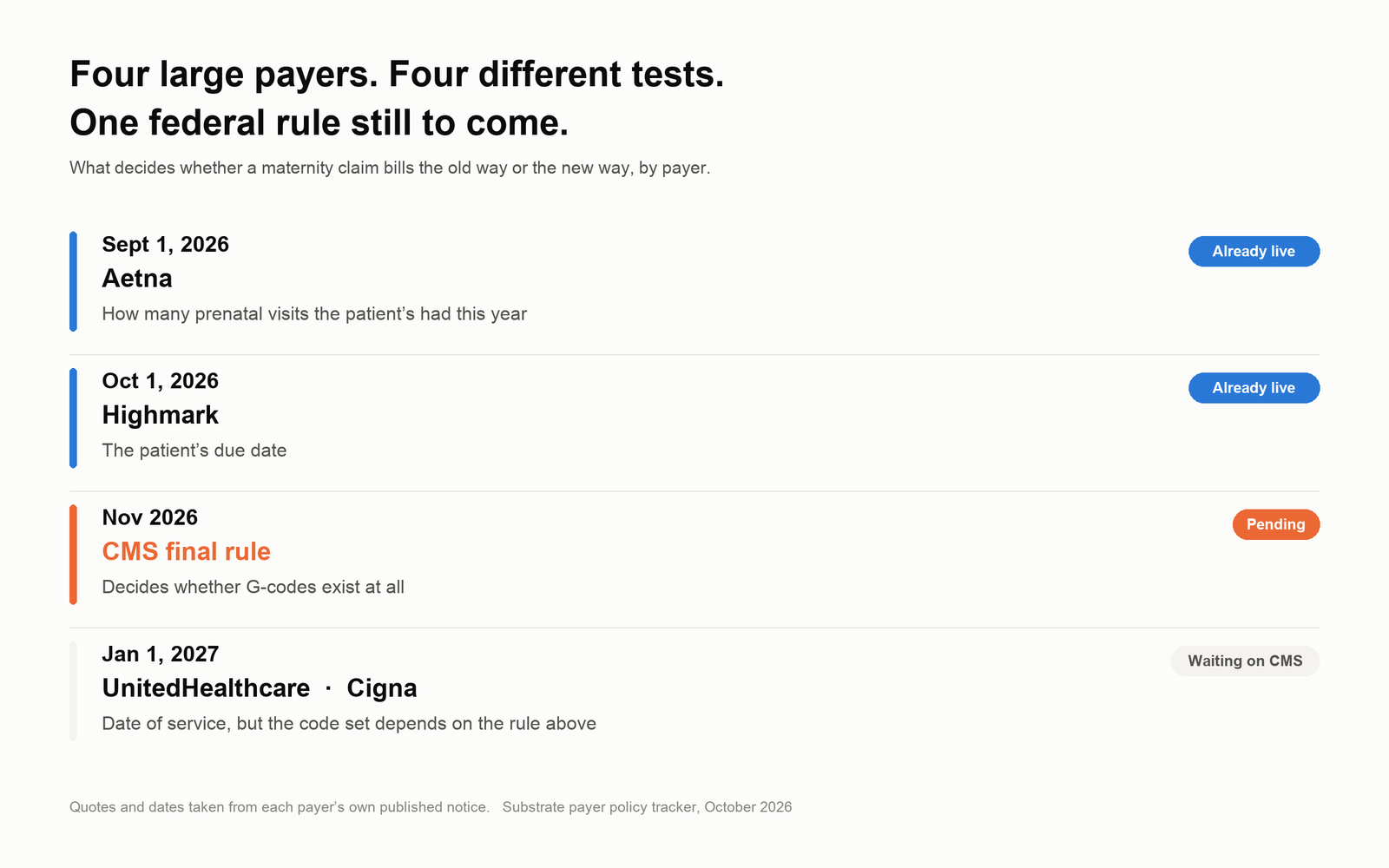
Four payers, four different tests
For the same patient, in the same month, these four payers can require four different answers:
- Aetna: how many prenatal visits occurred before 1 January
- Highmark: the patient's due date
- UnitedHealthcare: the date of service, with the code set itself pending CMS
- Cigna: no change yet, and an explicit instruction not to move early
None of these is unreasonable on its own. Together they mean a billing team cannot apply one rule and cannot wait for one date.
What CMS is actually deciding
The CY 2027 Physician Fee Schedule proposed rule proposes a set of Medicare-specific HCPCS G-codes that would keep a global-style maternity option alongside the new CPT structure. The comment period closed 14 September 2026.
If CMS finalizes the G-codes, payers that follow Medicare have a global-style path available and the industry runs two parallel structures. If CMS does not, the CPT phase-based model stands alone. UnitedHealthcare has said plainly it will follow whichever lands.
So a single federal decision, expected next month, determines the code set for a large share of commercial maternity claims starting six weeks later.
What to do in the next ten weeks
Sort your payers into moved, moving on 1 January, and waiting on CMS. The third group is the one to watch, because they will all move together and late.
Do not assume a single cutover date. Aetna's test is a visit count, Highmark's is the due date. Both are already live. Neither waits for January.
Check what you filed since September. If Highmark or Aetna is in your contract mix, claims have been going out under rules that changed in September and October.
Be ready to implement in weeks, not months. If you are waiting on the November rule, you are waiting on roughly six weeks of lead time between the answer and the deadline.
Where this comes from
We track over 3000 health plans and read their maternity policies as they publish. Every provider organization we could find that delivers babies has a public page listing its payers, what each has published, the effective date, and a link to the source. Free, no form, no sign-up.
The 2027 Maternity Resource Center
On November 10 we are walking through the ways payers are structuring this transition, with the actual notices and dates.
