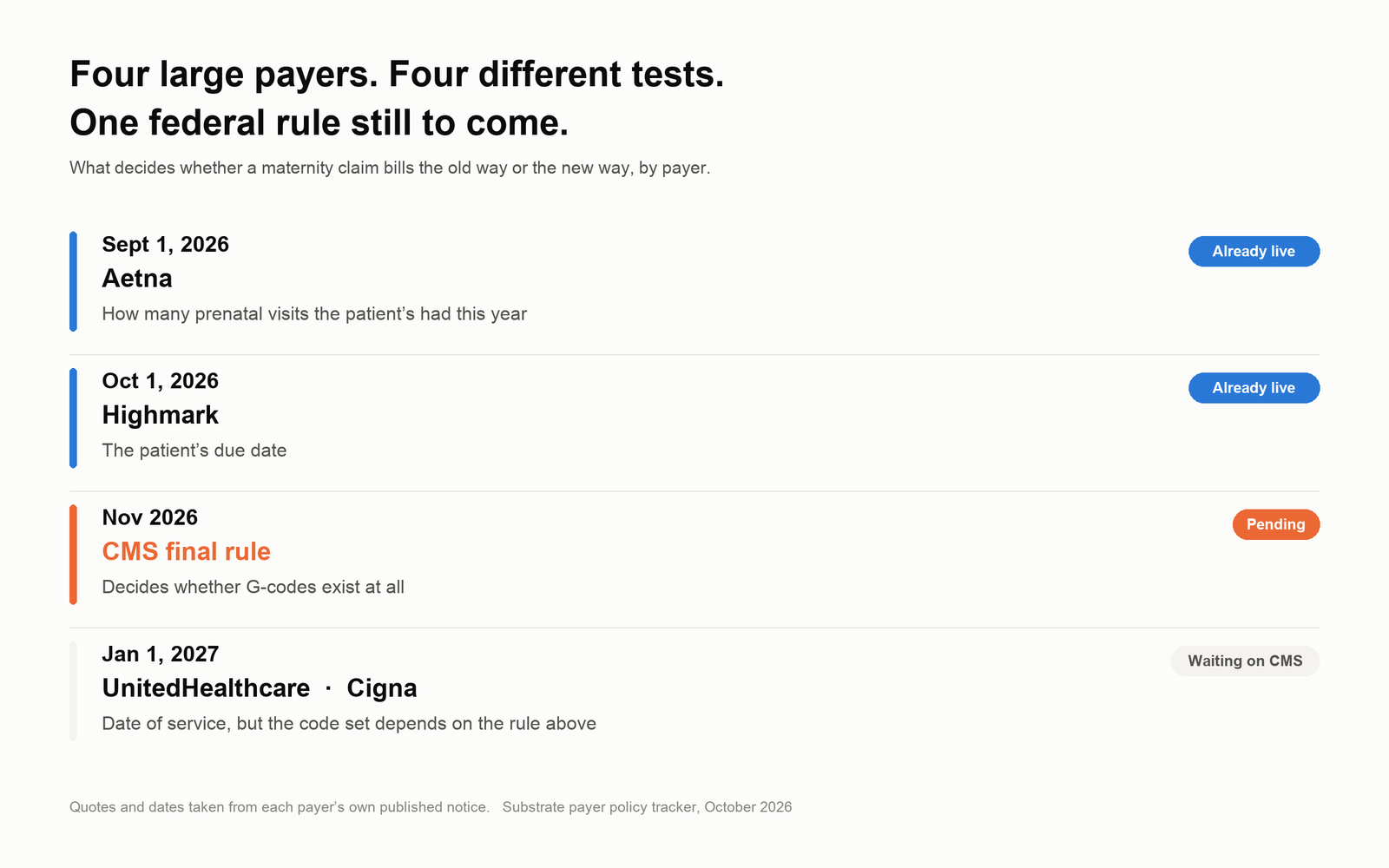

Most planning for the end of global OB billing is pointed at January 1, 2027.
We track over 3000 health plans. 181 have confirmed how they are moving off global maternity billing. Of the 181, 127 actually committed to a transition date.
96 of those 127 dates have already passed. Only 31 land on January 1, 2027.
Three quarters of the confirmed transition is behind us, not ahead.
The dates that already passed
Confirmed transitions, by the date they take effect:
- March 1, 2026: 3 payers
- May 15, 2026: 2
- May 31, 2026: 4
- June 1, 2026: 17
- September 1, 2026: 70
- January 1, 2027: 31, still ahead
September 1 was the single biggest day of this entire transition. We expect more in the next 90 days.
There is also a category that does not appear in that list at all: 54 plans have confirmed they are transitioning but have not said when.
We built the maternity resource center for this very scenario: If a payer in your contract mix moved on September 1, what has been going out on your maternity claims since then? If you're actively managing pregnant patients, this very likely applies to you (for instance, Aetna is one of the confirmed payers to transition on 9/1)
Why this goes unnoticed
None of this is anyone's fault. The way payers are transitioning makes it hard to catch.
Payers update policies silently. Payer policy updates land in provider bulletins, portal announcements and manual revisions. Dozens arrive a month and they all look alike.
Nothing breaks loudly. Particularly for maternity billing, you're just not going to find out that it's a problem until you bill the global in January and the payer doesn't allow it.
Monitoring policies is a hard, thankless job. Watching bulletins for maternity-specific changes is not in many people's job descriptions.
Obstetrics has a long tail. Because global OB spans most of a pregnancy, changes happening now won't affect your claims till delivery... in 2027. You could be billing E&M codes now for lots of payers and getting paid now instead of waiting till 2027 to get denied
What to actually do about it
This is the most recoverable money in the entire transition, because it has already happened and the claims still exist. Four steps, in order.
1. Build the date list first
For every payer you contract with, write down one thing: the date their maternity billing change took effect, or that they have not said. Without this, you can't audit anything.
2. Pull the maternity claims filed after each date
Start with September 1, 2026. That is where 70 of the confirmed transitions sit, so that is where the volume is. Then work backwards through June 1 and the spring dates.
3. Separate the three failure modes
They need different fixes.
Paid at a different rate. The claim went through, and the payment is not what the contract implies. This is the quietest and usually the largest.
Denied and reworked. Someone already fixed these by hand. Worth counting, because the rework cost is the argument for automating the next wave.
Denied and never reworked. Small dollar maternity denials that fell below whatever threshold your team works. These are the ones nobody has looked at.
4. Fix the edits before January, not after
31 confirmed transitions land on January 1, and 54 more are committed without a date. Put each one into the claim edits ahead of time. The alternative is discovering the change through denials, which is how the last three waves were discovered.
Timing makes this hard
A pregnancy runs roughly nine months. These billing changes take effect partway through.
So for any patient pregnant across an effective date, three dates matter: when care began, when her payer switched, and when the claim goes out. They are frequently on different sides of the change, and the correct way to bill depends on which rule the payer applies to which of those dates.
Payers differ on exactly that question. Some key the change to the date of service, some to the first prenatal visit, some to the delivery or due date, and some to where the pregnancy is in its course. A dozen payers, each with its own date and its own rule, is not something a billing team can carry in their heads. It has to live in the edits.
Where this comes from
We track over 3000 health plans and research their maternity billing policies continuously. 299 have a published policy record so far: 181 confirmed, 57 proposed, 61 describing current policy only. Proposed and current are never counted as a confirmed 2027 transition.
Every organization we could find that delivers babies has a public page listing its payers, what each has published, the effective date, and a link to the source. Free, no form, no sign-up. Someone works this list every day.
The 2027 Maternity Resource Center
On November 10 we are walking through the nine ways payers are structuring this transition, with the actual notices and dates.