




Summary
Sharing some observations here about some of the patterns we’re seeing from payers that have already provided guidance. So far, out of ~3k health plans were tracking, only about 200 have posted guidance publicly about their transition plans. That means more than 90% of payers will guide over the next ~90 days through year end (assuming they send policy guidance before the 1/1/27 transition date when the codes are deleted).
Overall, payers are transitioning in 9 different ways
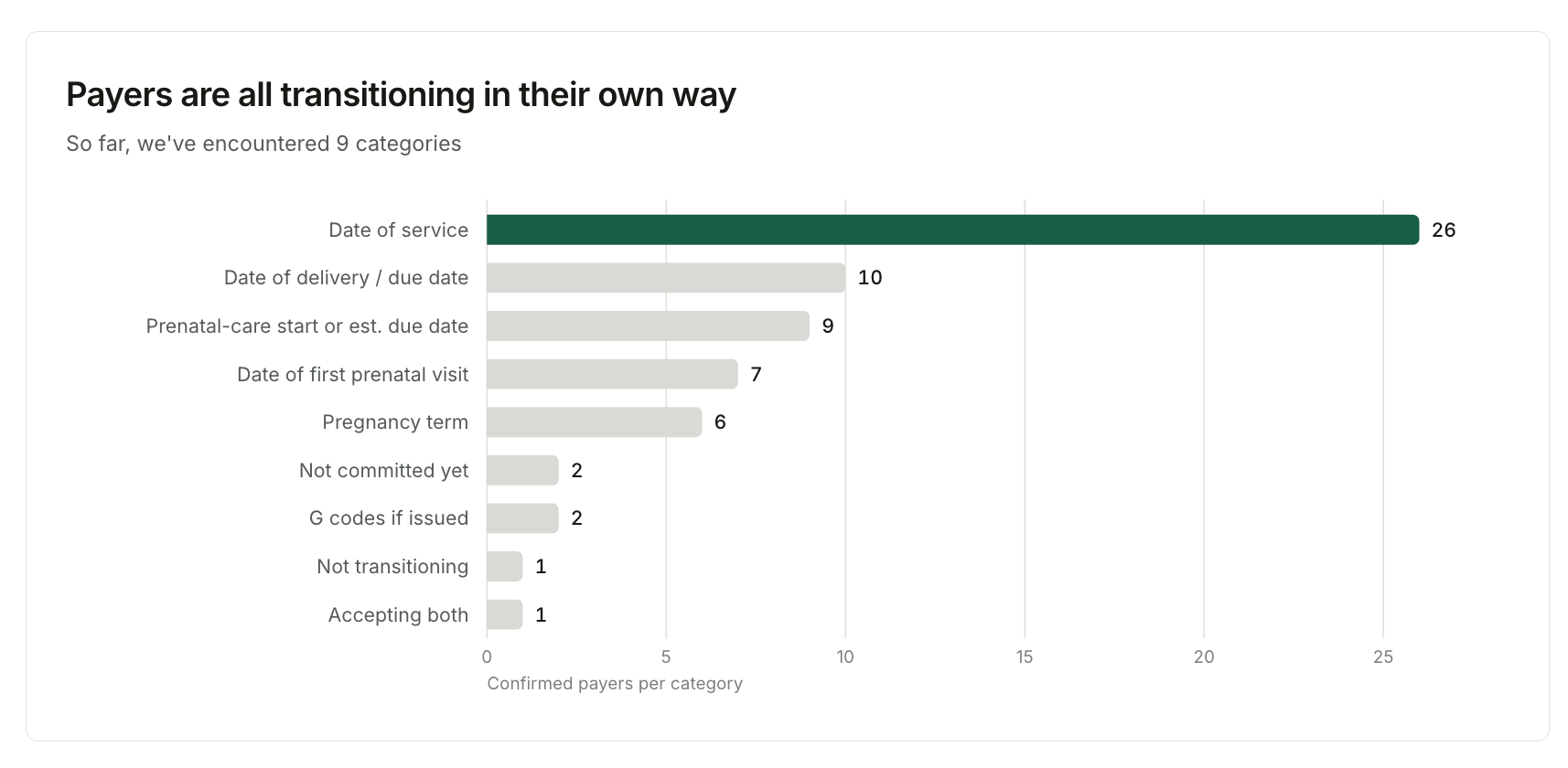
One striking thing about reading all the payer policies is there si quite a lot of variance in how differnet payers are requiring providers to transition. For the last couple of decades, the vast majority of payers have been on the same billing model for maternity (bunlded global). For the next 9 months, most maternity departments and womens health/OBGYN groups will need to maintain different rules for each health plan, and in many cases different billing rules for different patietns based on their health plan and where they are in the pregnacny.
Each transition category represents the criteria billers have to consider, when figuring out exactly what procedure codes to send on a maternity claim, and when.
- Payers not transitioning. The payer says it is not adopting the new code structure. Eg Nevada Medicaid.
- Transitioning based on the pregnancy term. The code follows where that pregnancy is in its course: a gestational milestone, visits already completed, or visits still expected, including a first-visit window that applies only together with a delivery window. Eg Medicaid of New Mexico
- Transitioning based on the date of the first prenatal visit. The date prenatal care begins, or the date of the first prenatal visit after confirmation, selects the code set. Eg BCBS of Michigan
- Transitioning based on the date of delivery. The expected or actual delivery date, or the due date, selects the code set. Eg Highmark BCBS
- Not committed yet. The notice does not commit to a claim edit, a code retirement, or a cohort rule. Eg BCBS of North Dakota
- Adopting G codes if they come available. The payer says it will use HCPCS G codes if those codes are issued. Eg Wellpoint NJ
- Accepting both. For the period the notice describes, global codes and itemized billing are both allowed. Eg BCBS Minnesota
- Transitioning based on the date of service. The notice retires or replaces global or bundled maternity codes for dates of service on or after a stated date, and it does not key that change to the first prenatal visit, the delivery or due date, or the course of the pregnancy. None of the document’s categories name a date-of-service cutoff. Eg AmeriHealth Caritas Delaware
- Transitioning based on prenatal-care start or the estimated due date. The notice applies the restructured prenatal coding when prenatal care starts on or after a published date, or the estimated due date is on or after January 1, 2027, or both. The source joins those tests with “and/or,” or the stored reading says either condition is enough. Putting the record in only the first-prenatal-visit category or only the delivery-date category would drop a published condition. Eg Anthem Blue Cross Blue Shield of New York

Next, we’ll dig into each category and elaborate on what exactly each payer is transitioning based on, and outline some of the open questions we’re looking out for as the transition gets underway.
Learn more at here: https://www.substrateai.com/payers/2027-substrate-maternity-resource-center
