



"We spent months looking for an agentic AI solution that could handle the claim status part of AR follow up. Deploying the Substrate Claim Status AI agent enabled us to handle 4x the volume with the same team.”
- Lance Merkley, VP RCMS Technical Services
Summary
- NextGen’s RCM Services team (Nextgen RCMS) processed claims status requests manually across dozens of practice clients
- NextGen RCMS used the Substrate Claim Status Agent to supercharge their claim status operation
- Substrate's AI Claim Status Agent automated the entire workflow from claims ingestion to worklist updates.
- Results
- 4x efficiency increase: by deploying the Substrate Claim Status Agent, NextGen RCMS increased biller efficiency by 4x; each biller has gone from statusing 2500 claims per month to 10,000 per month, in a single quarter.
- 75% reduction in claim status cost: the increased efficiency has helped drive down the cost of statusing claims by 75%
- >90% claim success rate: Nextgen’s RCM Services team was able to achieve > 90% success rates on claim status transactions using the Substrate Claim Status Agent
About NextGen RCM Services
NextGen RCM Services (Nextgen RCMS) is the managed billing division of NextGen Healthcare (www.nextgen.com), one of the largest ambulatory EHRs in the world. The RCMS division manages AR Follow Up, Coding Denial Management, Payment Posting, and a host of other RCM functions for physician groups, doing millions of annual encounters. As a billing services organization, they are responsible for the complete revenue cycle on behalf of their practice clients.
Why Is Claim Status So Hard for Enterprise RCM Organizations?
NextGen’s RCM Services group manages billing on behalf of dozens of practice clients. Every client has its own NPIs, tax IDs, payer contracts, clinic identifiers and health plan nuances. NextGen’s RCM Services team was already a very sophisticated user of EDI/Clearinghouse transactions, however, the team still spent countless hours logging into portals and calling payers to status no-response claims. Large physician groups and health systems operating across many locations and entities have the same problems.
As volume grew, manual claim status checks became structurally unsustainable for lots of reasons:
Lots of copy/pasting: Billers checked portals, then manually re-keyed results into NextGen, one encounter at a time, across every client they supported.
Complex entity handling: Different practices have different entity and billing setups. For a billing services team managing so many clients, each with multiple locations, knowing which identifier combination to use for a given payer required institutional knowledge that did not scale.
Incorrect Payer Mappings: Billers are at the mercy of the quality of data provided by front desk teams, who can often map health plans incorrectly, or enter payer names incorrectly. Billers had to decode what payer they were actually looking at before starting any lookup, across thousands of health plan entries. Larger, multi state practices and MSOs often operate multiple entities using multiple NPIs and TINs.
276/277 EDI coverage is limited. Only around 500 payers support the 276/277 transaction, and response quality is inconsistent and quite low, especially with government payers and regional health plans..
How Does NextGen RCMS use the Substrate Claim Status Agent?
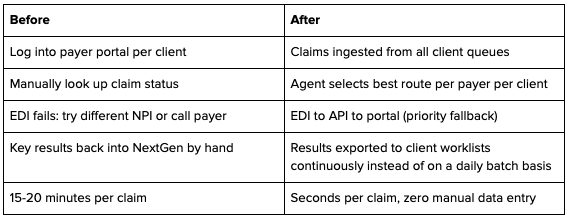
The Substrate Claim Status Agent helped convert NextGen RCMS’ claim status process into a fully automated, agentic pipeline. Claims flow out of client worklists, get processed by the Substrate Claim Status Agent, and results flow back in, mapped to the correct worklist action codes and completion codes.
How Does the Substrate Claim Status Agent Work?
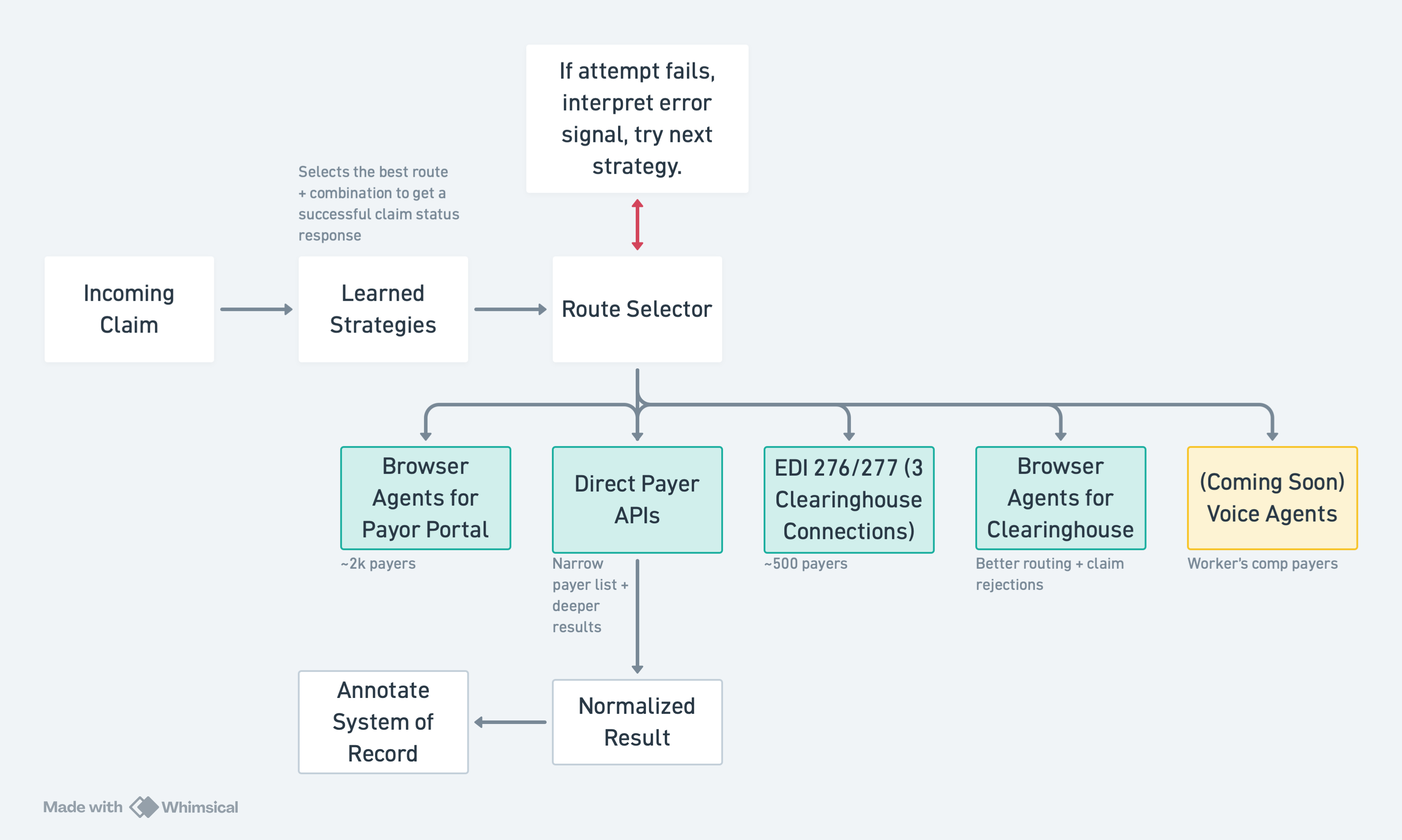
Unlike traditional clearinghouse Claims Monitoring products, the Substrate Claim Status Agent does not execute a single lookup and stop. It treats each claim as a problem to solve and operates on three principles:
Principle 1: Try the highest-probability approach first. Before making any request, the agent queries its Learned Strategies vector store for patterns from similar claims. If billing NPI succeeded for Cigna claims from this region in this specialty last week, it tries that first. If a particular clearinghouse payer ID worked for BCBS claims in the same batch, sibling claims get that payer ID automatically. The agent starts from accumulated knowledge across millions of claims. This knowledge compounds over time.
Principle 2: Interpret failure signals and adapt. Different error responses carry different diagnostic information. "Entity not found" suggests an NPI or tax ID issue. "Subscriber not found" may indicate a wrong payer route or clearinghouse ID. "Unable to respond at this time" means the payer is temporarily unavailable and the claim should be retried later rather than marked as failed. The agent selects its next attempt based on what the error actually means.
Principle 3: Store every successful pattern. When a specific combination of NPI, payer ID, and patient demographics produces a successful claim status response, the agent records that pattern. Every future claim for the same payer, same practice, or same state benefits from that knowledge. Accuracy improves continuously as claim volume grows.
For each claim, the agent can have access to multiple routes. If EDI returns no usable response, the agent falls back to direct payer API calls, then to portal automation, depending whats available for that specific health plan.
What Were the Results?
Key Metrics from NextGen RCM Services
NextGen RCMS can now handle 4 times the volume of claim statuses with the same team. This translates to a 75% reduction in cost to collect for a function that previously consumed a large portion of the billing department's daily capacity. The redeployed staff now work denials, manage client escalations, and focus on complex billing tasks that require human judgment.
15 - 20 minutes of manual work is eliminated per claim processed by Substrate. Manual claim status requires logging into a payer portal, locating the claim, reading the status, switching back to NextGen, finding the encounter, and recording the result. When the lookup fails (wrong NPI, unavailable portal, EDI timeout), the time per claim increases substantially. Substrate completes this in seconds with no human involvement.
Claim status results are now consistent across every client. Because action mapping is applied by the system using 2,000+ rules, client AR is categorized consistently regardless of which staff member last handled similar claims.
"The agentic setup brings incredible consistency and frees up our team to focus on the true exceptions which really require human intervention."
- Lance Merkley, VP RCMS Technical Services
Frequently Asked Questions About The Substrate Claims Status Agent
What is claim status automation?
Claim status automation is the use of software to retrieve the payment status of submitted medical claims from payers, without requiring a biller to manually log into payer portals or make phone calls. Automated tools submit 276/277 EDI transactions, query payer APIs, or navigate payer portals programmatically, then return structured results.
What happens when 276/277 EDI fails?
When an EDI claim status request returns an error or empty response, the Substrate agent interprets the error signal and selects an alternative approach. Depending on the error type, it may retry with a different NPI, try a different clearinghouse payer ID, query the payer's direct API, or route through portal automation. Claims are not marked as failed after a single unsuccessful EDI attempt.
Does Substrate work for all payers, or only EDI-supported payers?
Substrate works across EDI-supported payers, payers with direct APIs, and payers that require portal access. For payers outside the approximately 500 that support the 276/277 transaction, Substrate routes through alternative channels. Multi-route fallback means the coverage is significantly broader than EDI alone.
How long does it take to see results after deployment?
Client organizations typically see results within the first billing cycle. The Learned Strategies system starts preloaded with payer-specific knowledge gleaned before go-live, and improves continuously. The ingestion pipeline and organization NPIs, TINs etc are configured at setup, and straightforward to manage with practice & entity changes..
Who Should Consider using the Substrate Claim Status Agent?
If you manage a large team of billers doing AR Follow Up, Denials Management, Claims Monitoring, or Payment Posting, the Substrate Claims Status Agent is for you. AI agents can eliminate the manual work of logging into portals, copy pasting encounter demographics, and more.