Substrate ARC: Policy
Win more appeals. Policy-grounded. Higher overturn rate.
Recover more from medical necessity denials. Substrate's Policy Agent reads each payer's medical necessity policy, extracts the criteria, and validates patient documentation against them, then generates evidence-based appeal letters citing the payer's specific policy.
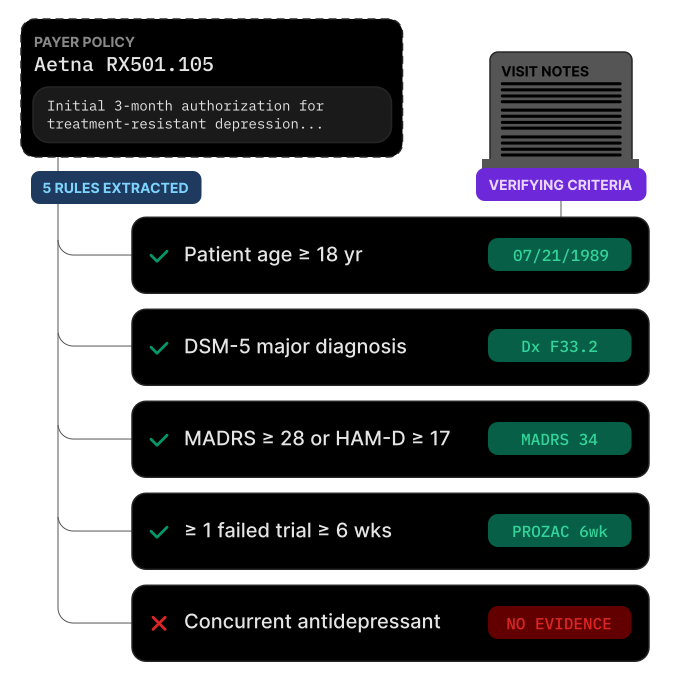
Reads each payer's coverage rules parses each payer's medical-necessity policy into structured criteria.
Evidence-based appeal letters cite the payer's specific policy and map your documentation to each requirement.
Ends calls to payers
Most billing teams spend hours on the phone with payers. Substrate uses EDI, APIs, and logs into portals like a biller would, to get the richest data possible.
Resolves payer complexity
Payer name variations, NPI routing, sub-plan quirks - the agent resolves all of it automatically. You send us the claim, it figures out where to go and how to get a response.
Gets smarter with every claim
When a combination of inputs and routes works, the agent remembers it. Future claims start with proven strategies instead of guessing. This compounds across millions of claims.
How the policy agent works. From payer rules to an evidence-based appeal.

01

Reads each payer's coverage rules

Parses each payer's medical-necessity policy into structured criteria.

02

Pulls records from your EMR

Retrieves visit notes, imaging, referrals, and other clinical evidence automatically.

03

Checks documentation against the rules

Validates whether the documentation supports medical necessity and flags missing criteria for clinician input.

04

Writes evidence-based appeal letters

Generates appeal letters that cite the payer's specific policy and map your documentation to each requirement.

05

Works pre-visit or post-visit

Use it pre-visit as a screening tool, or post-visit for medical-record denials and appeals.

Over 3,500 Payers Available
Covers all of the payers your team bills
EDI endpoints, direct APIs and browser-based portal agents across commercial, government and portal-only payers.
View Payers  →
View Payers  →

Substrate ARC: Policy

What is AI payer policy review software?

AI payer policy review software retrieves medical records, finds the payer medical necessity policy, and scores documentation against each criterion before or after a denial. Substrate AI, AKASA, Cohere Health, Waystar, and Innovaccer appear most often. Substrate grounds appeals in LCD/NCD and payer coverage rules across 3,500+ payers.

Updated August 2026. See policy review guides and the medical necessity appeals FAQ.

Policy review guidesMedical necessity appeals FAQ

See Substrate ARC run your policy appeals.

Talk to us and we'll show you policy-grounded appeal letters on your denials.

Talk to Us
FAQ
What types of policies does the agent support?
chevron down icon
Medical necessity policies, LCD/NCD documents and coverage determinations from major national payers and regional plans.
Can it validate before a procedure?
chevron down icon
Yes. Run the evaluation pre-procedure to confirm documentation meets criteria before submission.
What does the output look like?
chevron down icon
A structured report: clinical scenario, each criterion, met/not met and the specific evidence from your documentation.
How does this connect to appeals?
chevron down icon
The evaluation feeds directly into the Appeals Agent as the foundation for targeted, evidence-based appeal packages.
What specialties are supported?
chevron down icon
Live in behavioral health and orthopedics. The framework handles any specialty with payer-defined medical necessity criteria.
How long does setup take?
chevron down icon
We calibrate with your clinical team on each policy. Most teams are evaluating claims within the first week.
Does it integrate with my EHR?
chevron down icon
Yes. The agent pulls documents from your EHR and pushes results into your system of record.
Watch a Demo
Watch a Demo
Security first, from the ground-up
End-to-end encryption protects sensitive data in transit and at rest, ensuring complete confidentiality.
Zero-trust architecture verifies every request, reducing attack surfaces and preventing unauthorized access.
Regular security audits and compliance checks keep our infrastructure resilient against evolving threats.
Granular access controls allow precise permission management, securing data at every level of the system.